Anki How to Change Again and Good Interval
I take slaved over perfecting my Anki settings. I spend near 3-5 hours on Anki every solar day. I started doing Anki religiously in November of 2019, which is well-nigh 2,300 hours on Anki. That's crazy. I know it's crazy though. Then If I am this crazy, and spending this much of my precious life with Anki, I better be using it as best as I can.
If you lot want to only skip to screenshots of my settings just click hither.
I have found the settings, that I think, work best. These settings avoid "Ease Hell," optimize retentivity inside a 1-2 year time period (the first 2 years of medical schoolhouse), and prevent excessive card buildup. As well, I have tried to tinker with these settings for understanding as opposed to memorization . I want to understand, non memorize, these cards.
In this post, I will bear witness you every one of my Anki settings and the explanation behind each one too.
If you lot are completely new to Anki in Medical school I take a post on setting upward Anki with the AnKing for the beginning time here.
- General Settings
-
- Basic
- Scheduling
- Network & Backup
-
- Deck Settings
-
- Groundwork Data
- New Cards
- Reviews
- Lapses
- General
- Fuzz Factor
- Terminal Tips
-
- Pictures of My Recommended Settings For Medical School
General Settings
As a disclaimer, these are just the settings I have found to work best for me in medical schoolhouse. These may not be optimal settings for learning other things such as a new language or for how you lot learn individually. At that place are no "perfect" settings. Yous should read this post to get a good agreement of what the Anki settings and algorithms mean and "adept" settings to showtime off with. Then, play effectually with them to match your learning style.
My settings are adapted from the AnKing'south, Conaanaa's, and MedShamin'southward guides. I noticed, nearly 6 months in that certain settings weren't working out too for me, like the "again" setting and max-time interval. I adapted those to work for me. This is a long, merely I think fairly helpful post. Buckle in.
Let'south commencement with preferences.
To access preferences go to:
Top Toolbar → Anki → Preferences
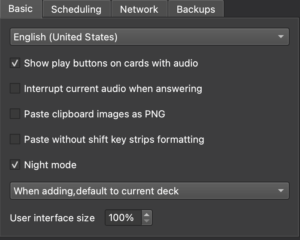
Basic
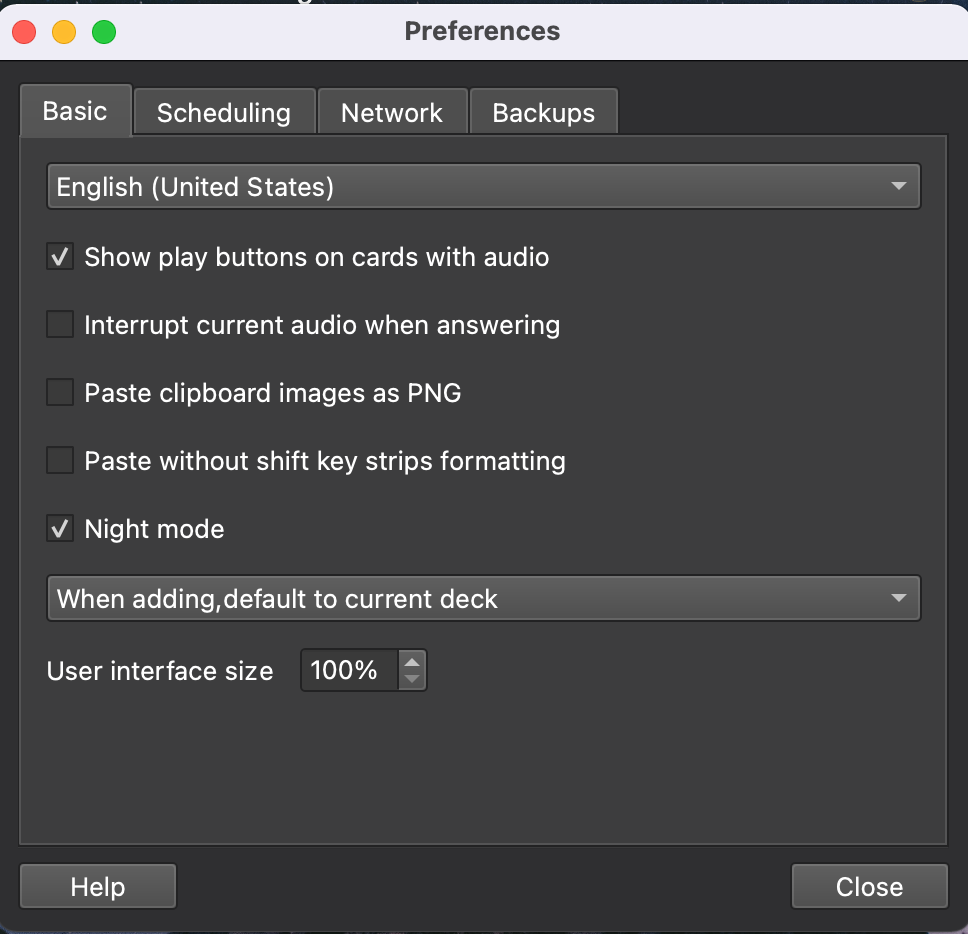
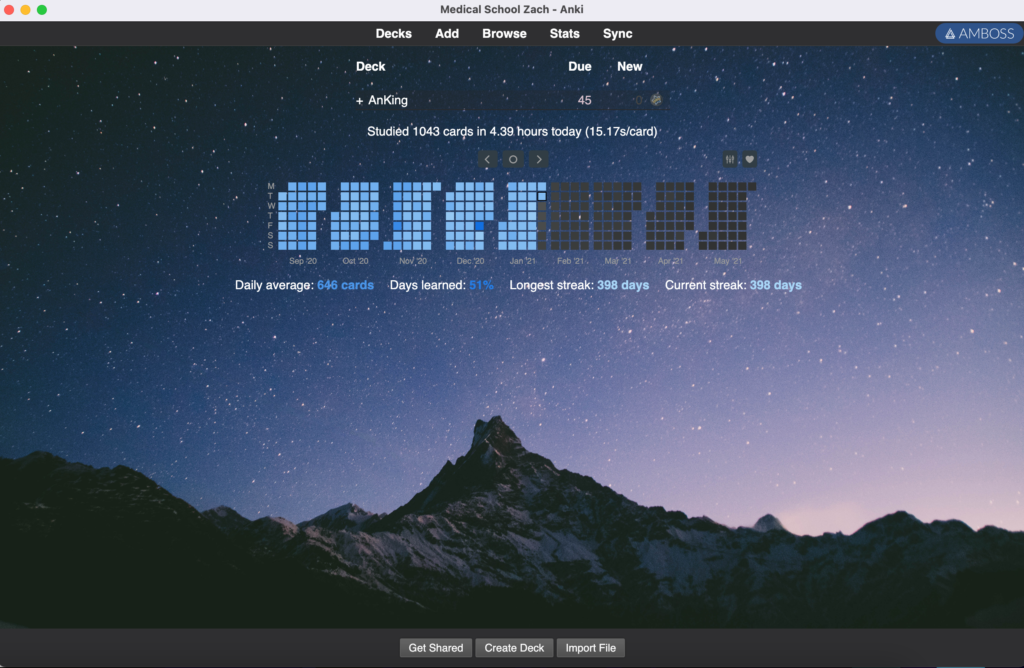
The only thing worth mentioning here is "Night Mode." This setting makes my deck take a gray background normally with white text. Night mode means certain things about my Anki will look dissimilar, as shown on my Anki beneath:
If y'all want a guide on how to customize your Anki groundwork click here.
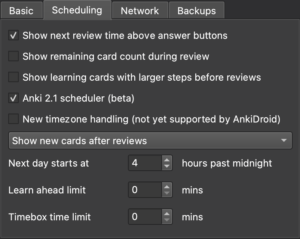
Scheduling
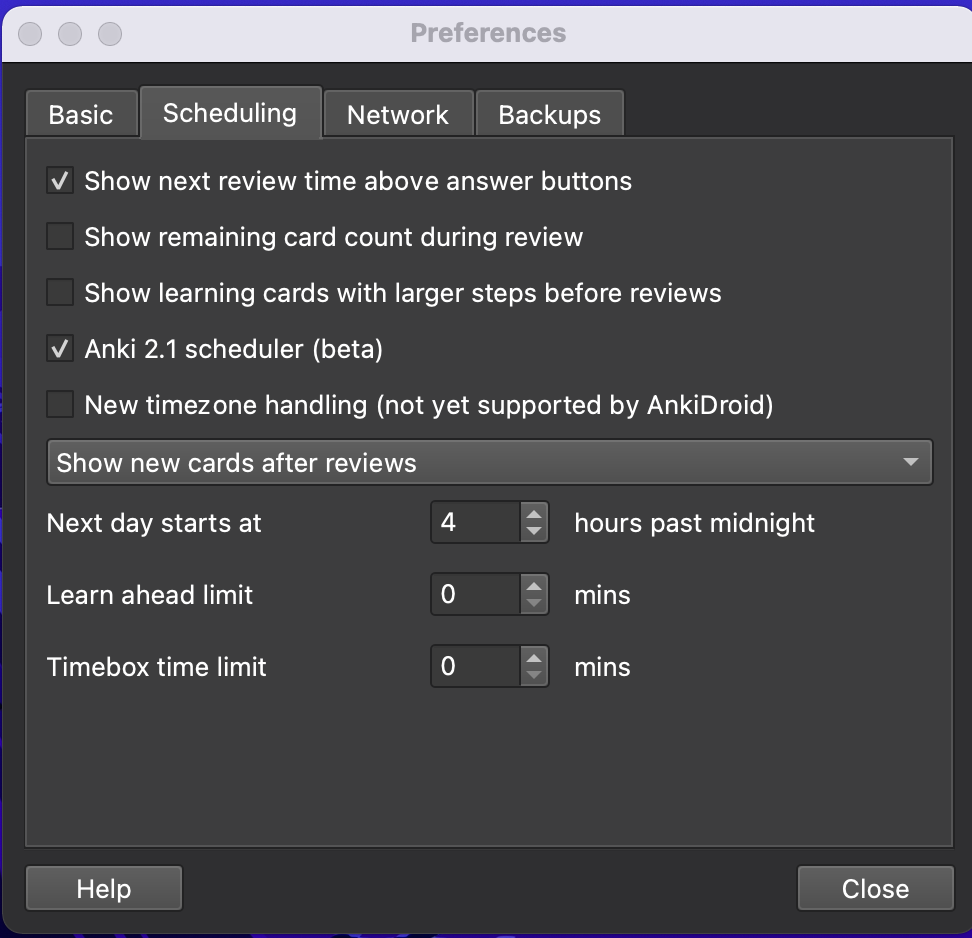
This is the about important section in preferences.

"Show next review fourth dimension above answer buttons" is the deviation between this:
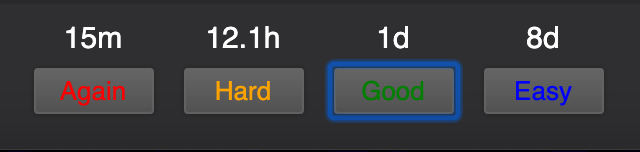
and this:

I think it'southward better to go out information technology enabled so yous can monitor to see if Anki is doing anything funky with your review times. Also, information technology'southward beneficial to know how far in the future your cards are being pushed if you accept an exam coming upwardly.
For case, my Step 1 exam is in 2 months, so I know if I see "3 months" on the "good" push, I better know that card because I won't be seeing it again earlier I have my exam.

I go out "show remaining card count" unchecked. I feel that it is distracting and makes information technology more about smashing through the number of cards than understanding the data.
I detect myself staring at that number.
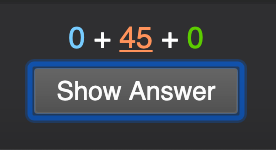
The only other one worth mentioning is the 2.1 scheduler beta. I enable this setting. Some benefits of this (a total listing of changes tin can exist constitute here):

- Reviews testify up in random order (This is the most important change, in older versions of Anki reviews would testify up in guild. I do non retrieve that is best for reviewing information for an exam. How will nosotros be tested, in order? Probably not, let's mimic exam mean solar day as much as possible and have our reviews bear witness upwardly in random order).
- Filtered decks work much improve (cards stats don't reset when building or deleting decks)
- Suspending/burying cards doesn't affect learning steps
- Learning cards now have a "hard" button, this is just the average of your "again" and "good" learning footstep. So my "again" step is fifteen minutes and my "good" step is 1 solar day and then my "hard" step is ~12 hours.

The next setting is the gild of cards to be shown. I select "Show new cards afterward reviews."
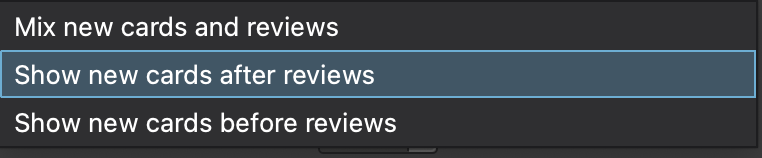
This is because I want to review all of the information that settled in my brain overnight first. So I will learn whatsoever new cards leftover from the day earlier. Then I will learn the new content for today from tertiary-party content, unsuspend those new cards, then report them.
You can check out my daily report routine here.
Finally, I accept the "new day" start at 4 am. This is the time at which the "next day" is registered by Anki. That means cards that are destined for the next calendar day announced at 4 am that mean solar day. If you study tardily into the dark or get-go studying really early in the morning, you might desire to change this setting. I am never up by 10 pm studying, and never upwards before five am. So I ready it for iv am.

The concluding setting worth mention here is the learn alee limit. This ways if Anki pushed a card 15 minutes into the future, as it what happens for me when I hit "again," if the "learn alee limit" is 15 minutes, I could review information technology now (0 minutes after hitting "again"). However, if it is prepare at 0, every bit mine is, I accept to wait that 15 minutes before I see this card.
I would never change this setting unless you are trying to get through these cards before bed, or demand to become through the cards in a short amount of time for some reason.

When you mess with this setting y'all are messing with the algorithm. We want to minimize that as much as possible. We like the Anki algorithm.
The final setting seems like Anki's attempt at a Pomodoro congenital-in timer, or some sort of timer. Information technology isn't that great. Information technology just will tell yous how many cards you lot've reviewed later a certain amount of time.

If I had this as "one minute," it would tell me how many cards I reviewed after 1 minute.
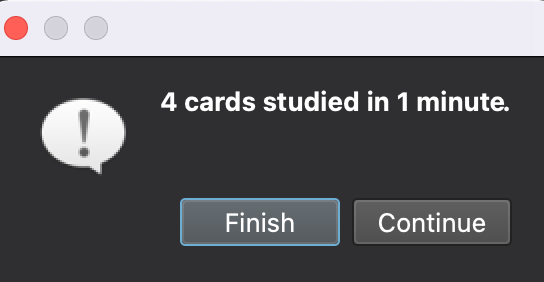
If you hit "Finish," it takes you out of the deck to the deck browser. If yous hit "Continue" you enter into another cycle. I would disable this. There are improve Pomodoro timers. The one I apply is the Be Focused – Focus Timer available on the Apple store. Some other fun selection is the Wood timer for your telephone. I talk almost these in my post hither.
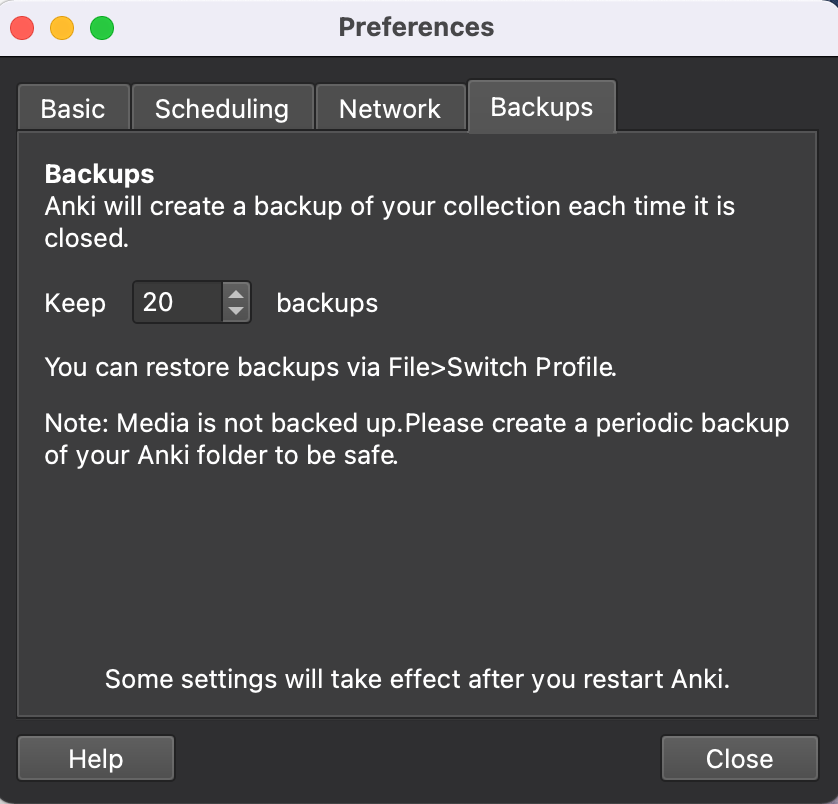
Network & Backup
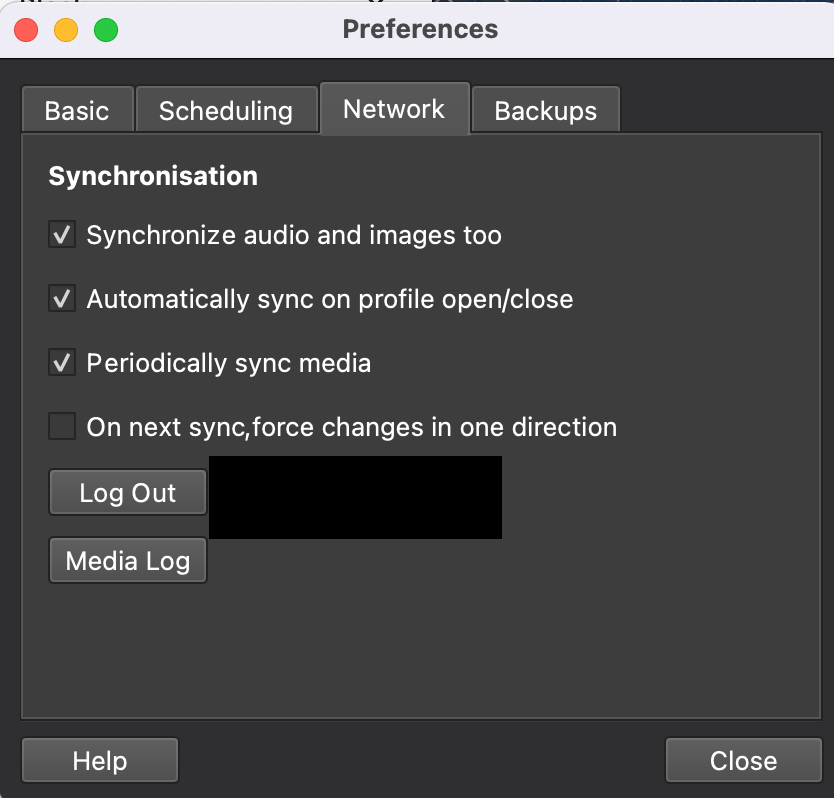
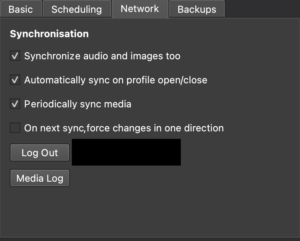
Non much to mention hither. I just have the "on next sync" disabled. As I don't like forcing changes in whatsoever direction. These settings will automatically sync your Anki occasionally, with images, and automatically sync whenever y'all open or close Anki.
Deck Settings
Now we are on the nearly important office. The deck settings are going to be what defines how oft y'all see your cards and, therefore, play a large function in your retention of these cards.
Background Information
If y'all want to just skip to the images of my settings click here.
Learning Anki cards can exist separated into two phases. "Learning" and "Graduated."
When yous get-go unsuspend or add a carte du jour it is a new card in the "Learning" stage.
After you complete a certain number of "learning steps" (similar hitting "good" at day 1 and striking "expert" again at day 3), your carte is "graduated." Confused? I was too, let's explain it a piddling better:
Try and ignore the specific settings, for now, focus on the "Steps." The "Steps" is your "Learning" phase. I want to give a background of what this all ways.
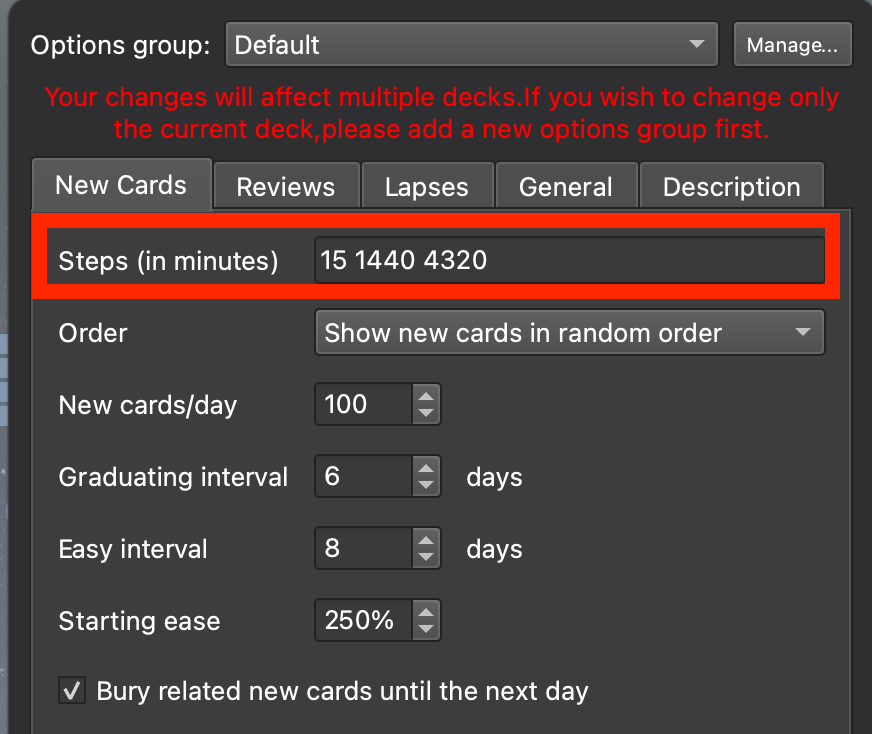
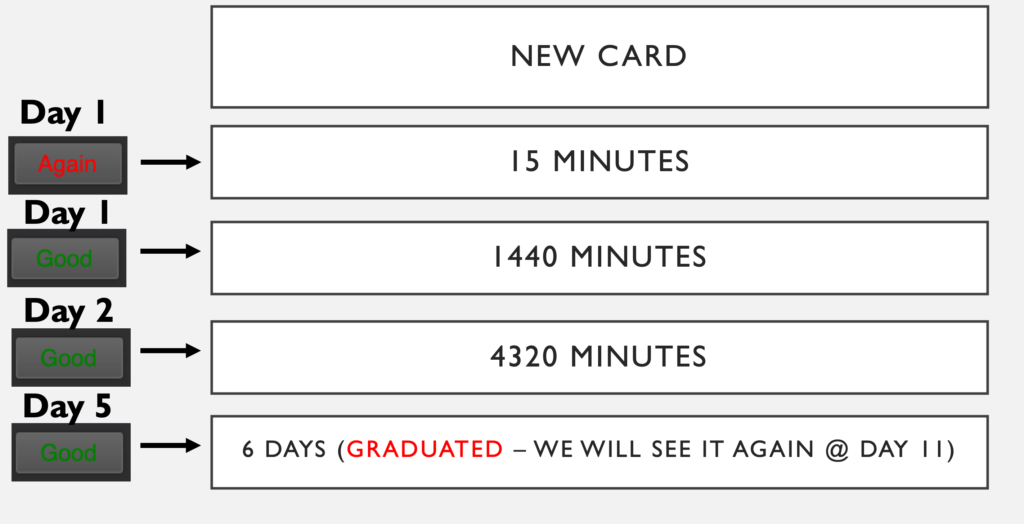
This means, when you are learning a new menu y'all volition see it at set intervals depending on what you select:
- If you don't know it and hit "again," the card will be shown to y'all in 15 minutes.
- If you practice know information technology and hit"skilful," the card volition be shown to you lot in ane 24-hour interval (1440 minutes is the number of minutes in one twenty-four hour period)
- On day 2, if you all the same know information technology and hit "good," the bill of fare volition be shown to you once again in 3 days (4320 minutes is 3 days) and the card is graduated.
- On day 6 post-learning, the carte du jour is graduated and is subject to the normal Anki algorithm (which will exist explained shortly)
- If at any betoken in this "learning phase" you striking "easy" the card will immediately be graduated and sent 8 days into the future. This is the "Easy Interval."
- If at any bespeak in the "learning phase" you hit "again," the carte du jour is sent back to its showtime "learning step" and you lot will see that card again in fifteen minutes.
So what is the "normal" algorithm of Anki? And how are our graduated cards treated differently? I'm glad you asked.
Normally, when you lot striking "good," it is two.5 x the current interval. But this simply applies to graduated cards . So if your graduated card was at a 1-solar day interval, and you hit "skilful," the card volition show upwardly at iii days, and then if you lot hitting "proficient" once again, at vii days, and then on…
Merely in that location are more buttons, every time y'all hit 1 of those buttons, "over again," "hard," "good," or "piece of cake," Anki applies a different algorithm on that menu to make up one's mind the side by side time yous will encounter that carte du jour.
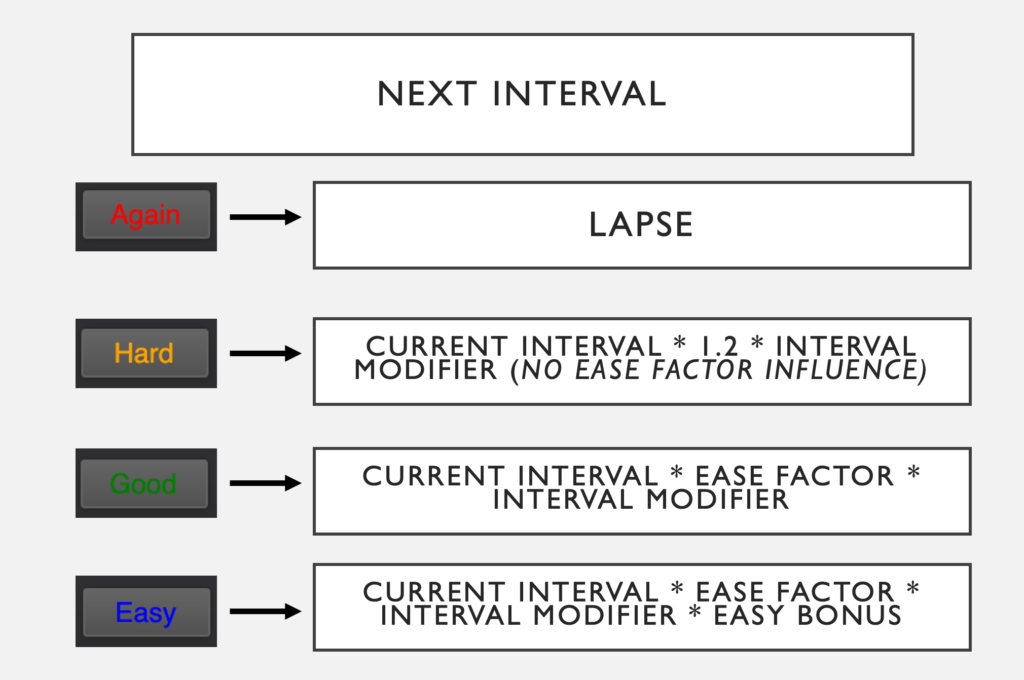
In that location are many new and confusing terms above, don't worry almost that yet, I volition explicate all of them as the postal service goes on. Start by looking at "Lapse."
A lapse is a card you didn't know, that's why yous hit "again," and this menu will enter a new "re-learning" phase. This is what happens whenever you lot hitting "again." What that means is that you will accept to relearn that data at a pre-set up interval (in settings that nosotros will become over later) earlier you tin "re-graduate" that card.
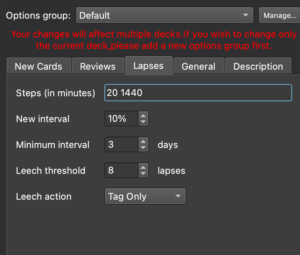
For example, my lapse settings are:
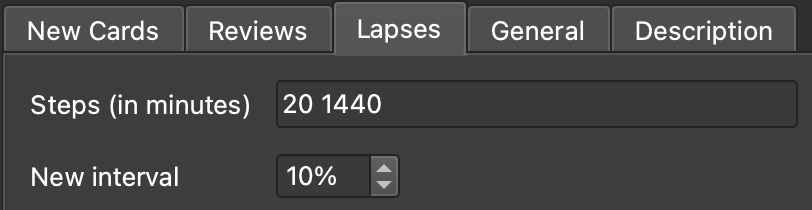
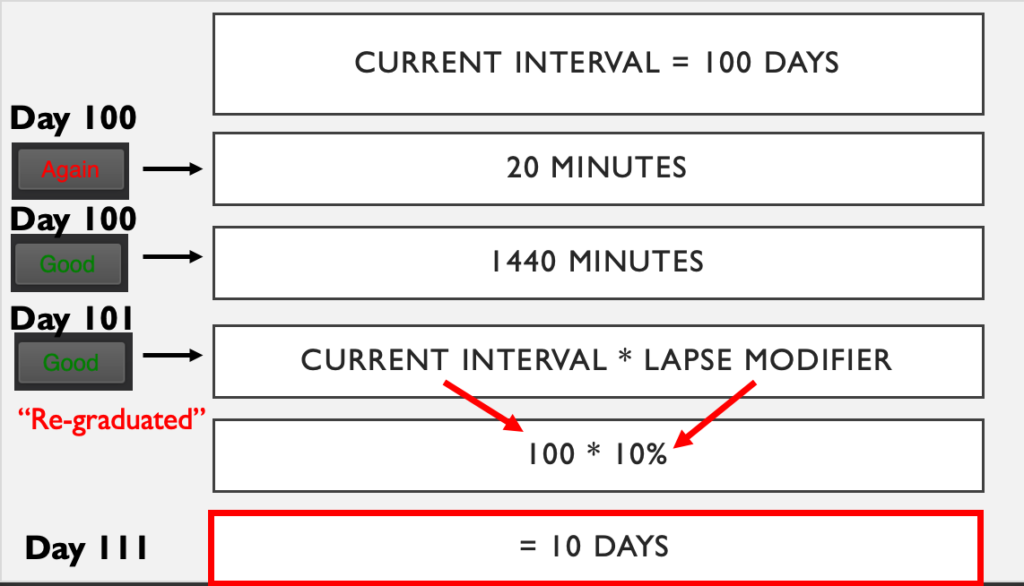
So, if I hit "again" on a carte du jour that was at an interval of 100 days I would be shown the card in 20 minutes. Then, if I hit "good," I will be shown that carte in 1 mean solar day. And then, if I hitting "good," again I will encounter that carte du jour in 10 days. That card has "re-graduated."
Why 10 days? Well, my "new interval" is set to ten%. So this means, when I lapse or hit "again" on a card, and I go through my 20 minutes and 1-day re-test, the card is put back on the schedule at x% of what it was originally. Then it was originally 100 days, and so now it is 10 days.
Now for the "difficult" office.
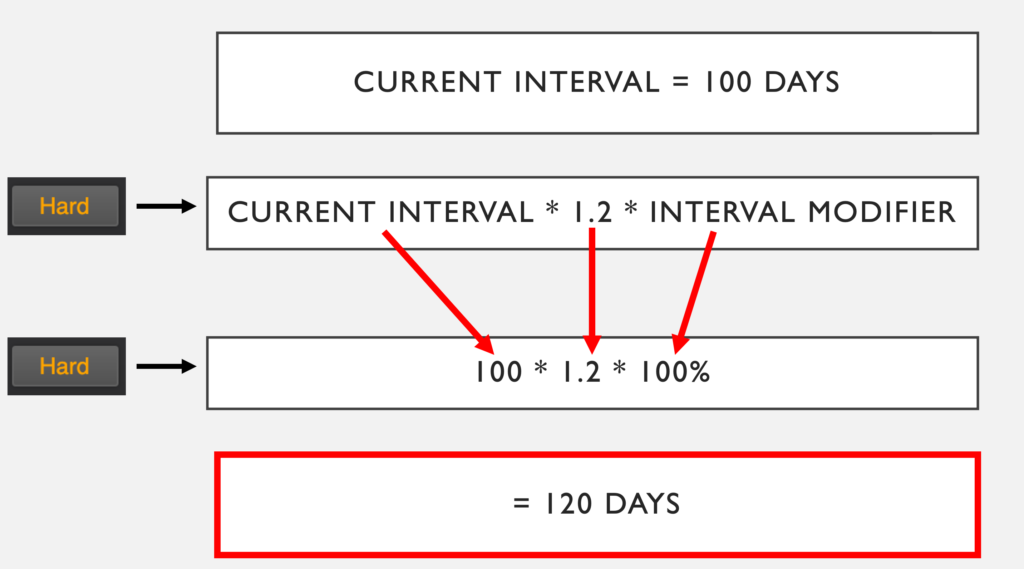
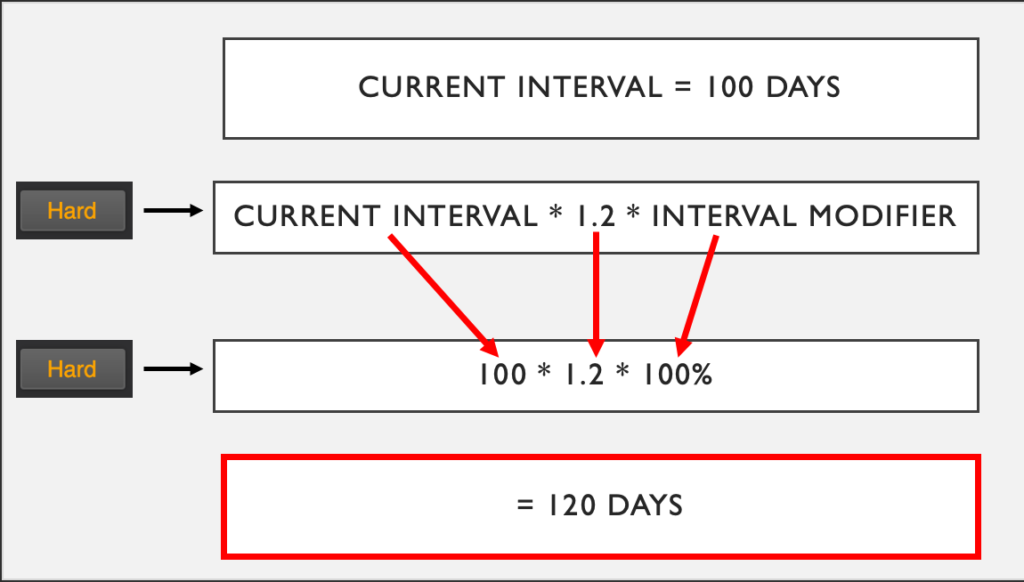
The "hard" button is fairly simple, but what is this new word, current interval?
The electric current interval is the interval of the card is right now, so let'southward apply the 100 days example. And so the electric current interval is 100 days, which means I saw this menu 100 days ago.
1.2 is exactly that, i.two.
Interval Modifier is a static number you set up in the settings. For now, I volition just tell y'all I go out that at 100%. This means it does nothing as 1*ane=1 as far as I know.
And then, if we hit "difficult," the card volition show up in 120 days.
Now, onto the "expert" part.
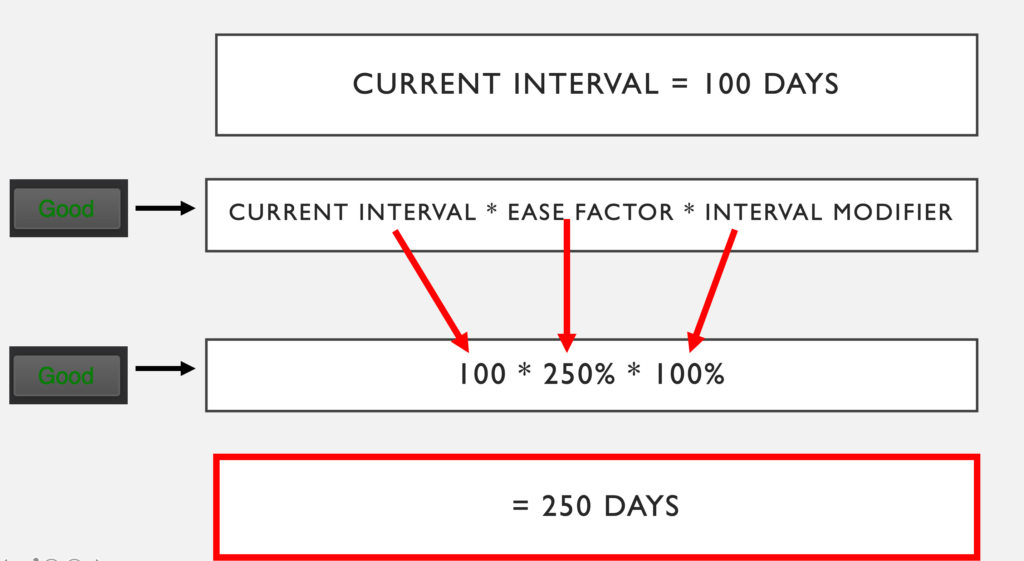
Current Interval we know and Interval Modifier we know, only what is this "Ease Factor?"
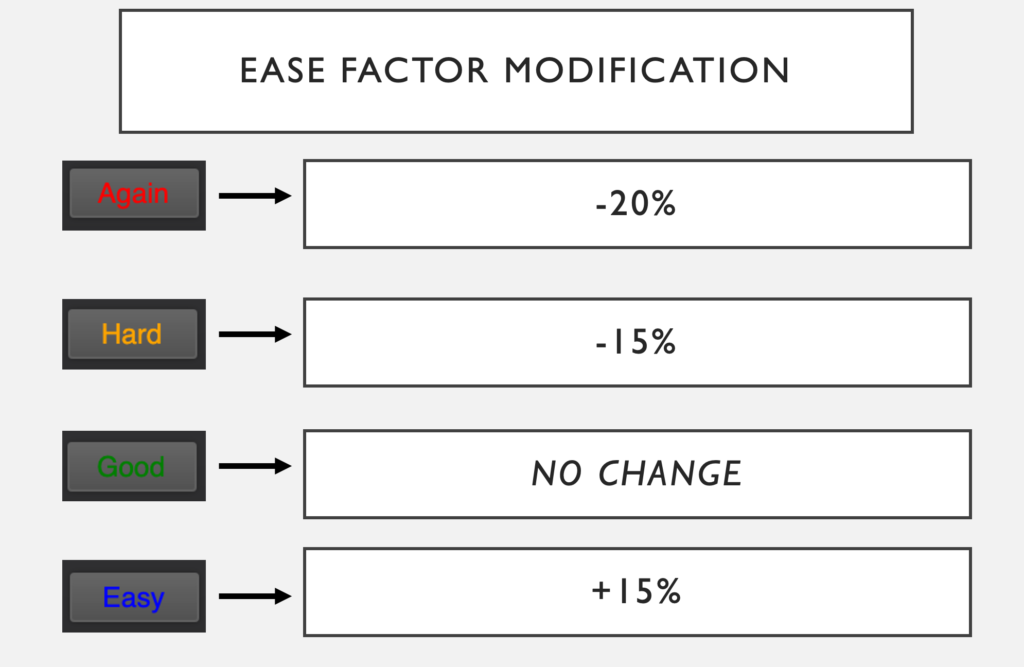
The Ease Factor is a unique characteristic of every carte du jour. It is initially set at 250%. I recommend never changing this. Importantly, yet, Ease Factor volition change specific to the card you lot are doing as y'all reply "again," hard," "good," or "easy." So when we have a fresh new graduated menu, that has left the learning phase, that menu is at an Ease Factor of 250%. Every time nosotros practice that card, however, depending on our answer, the ease gene is changed every bit shown below:
Then using our same example of 100 days, if we striking "skilful" nosotros will see the carte du jour at:
Current Interval (100 days) * Interval Modifier (100%) * Ease Factor (250%)
So nosotros volition run across that carte in 250 days.
If nosotros hit "hard" or "once again" we would run across that card at the interval described before, Simply, our Ease Cistron for that card is now changed. If nosotros hitting "again" the ease factor is now 230%, if we hit "hard," the Ease Factor is now 235%.
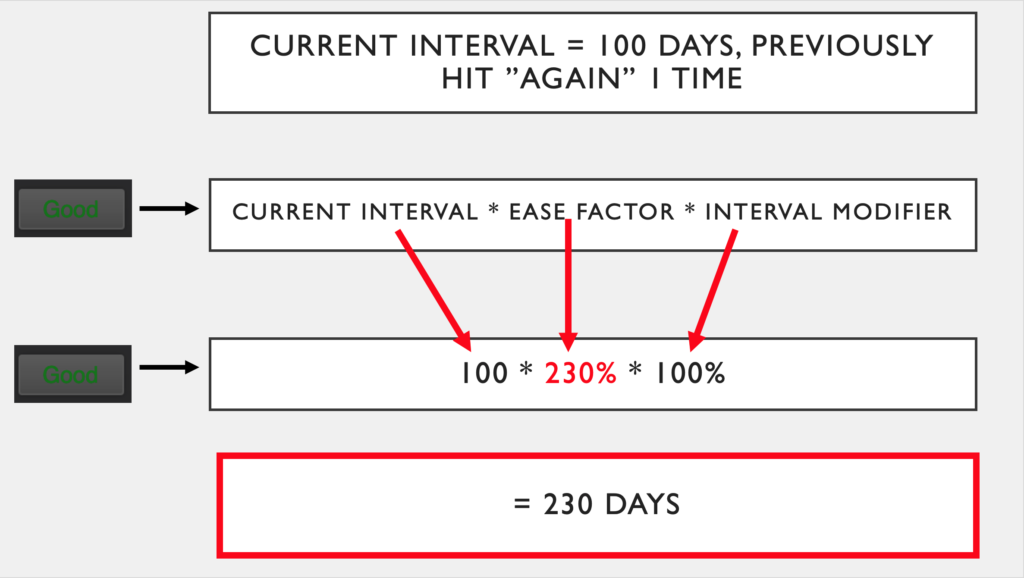
Why is that? Well our Ease Factor is at present 230%, so instead of:
Current Interval (100 days) * Interval Modifier (100%) * Ease Cistron (250%) = 250 Days
information technology is:
Current Interval (100 days) * Interval Modifier (100%) * Ease Factor ( 230% ) = 230 Days
I hope this makes sense, equally an understanding of this is important for the settings I have.
Finally, we are on to the "Easy" part.
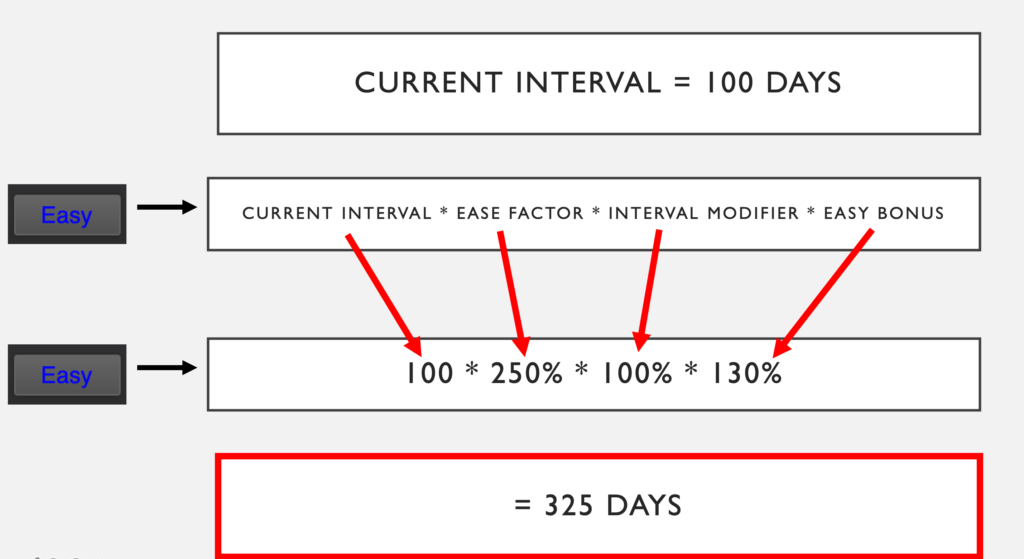
What is "Easy Bonus?"
Easy Bonus is simply a static number we can set in the settings, just like Electric current Interval, that is multiplied to the final interval.
Easy Bonus is normally set at 130%.
Ok, well washed if you got through that. I call up that information is necessary if you desire to get the almost out of Anki and sympathize my settings.
Now, onto the adept stuff, onto my settings.
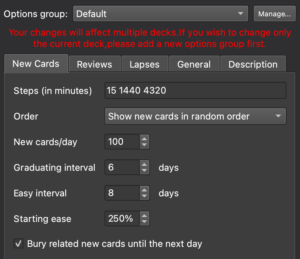
New Cards
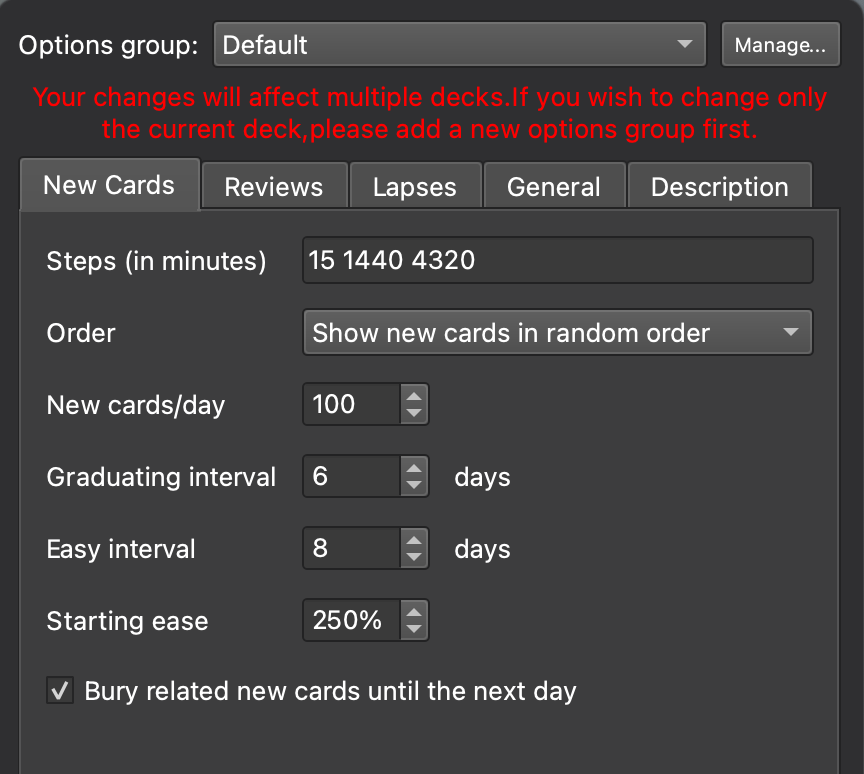
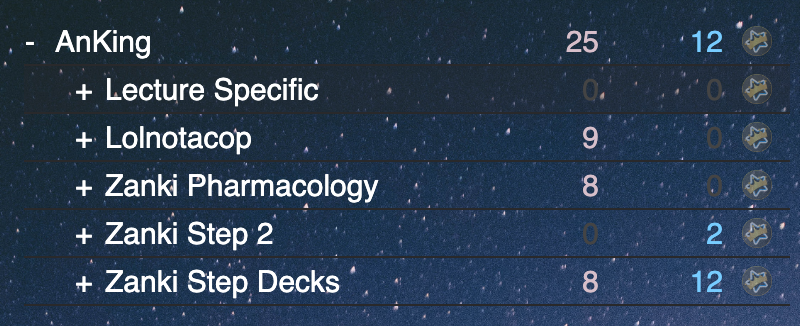
To access this binder go click on the cogwheel next to your deck. I like to keep all my decks the same blazon, "Default." As you lot can see all of my decks are under the "AnKing."
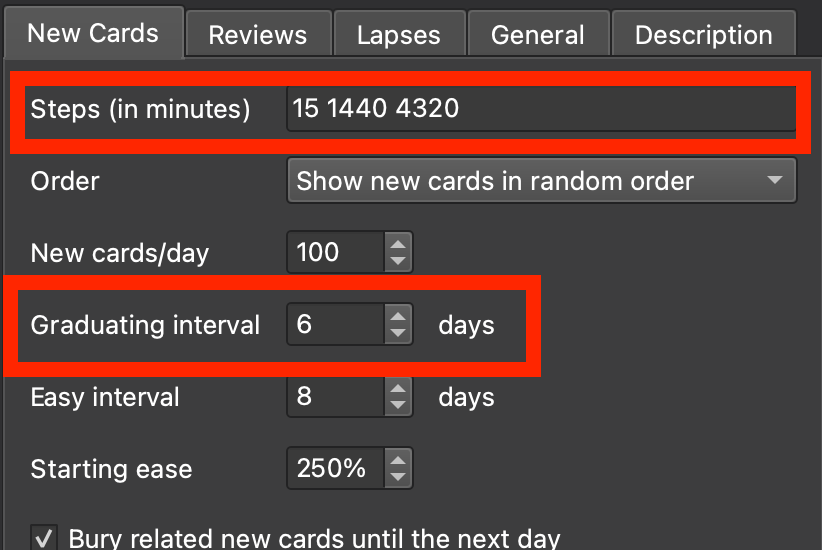
So, this is the important part, what are the steps? Well, we talked most it earlier correct. Steps are when your cards are in the "Learning" phase. Here is what I didn't mention earlier when your cards are in the "Learning" stage, they are condom from Ease Factor modification.
One time cards are "graduated" they are affected by the Ease Factor.
How do we "graduate" cards? Well if we become to the settings of Steps and Graduating Interval, once nosotros hit "adept" on our terminal learning pace, the carte du jour is graduated and we will see at our "Graduating Interval."
Run across New Bill of fare → Striking "skillful" → We see the menu 1 day later → We hit "practiced" → Nosotros at present see the carte 3 days afterward → we hit "practiced" → the card is now graduated and we meet it half-dozen days later.
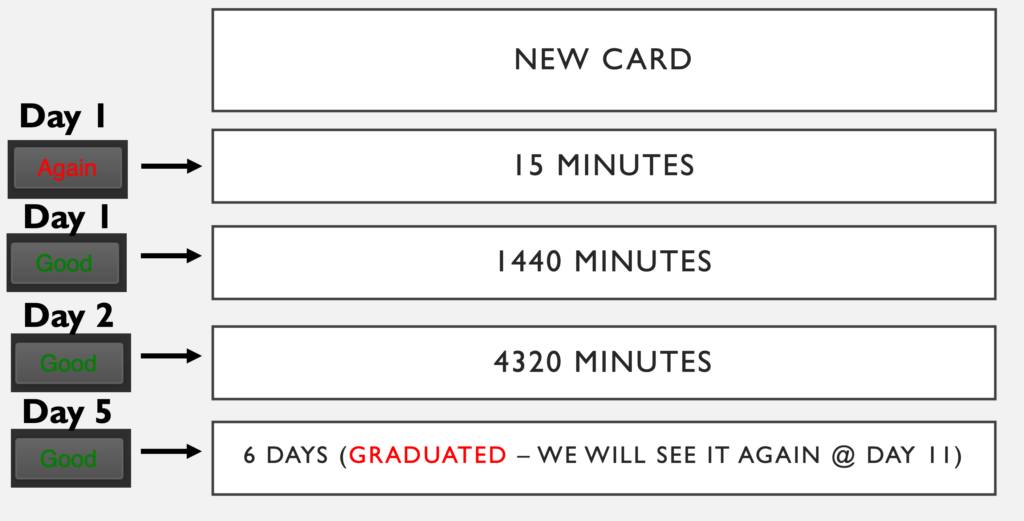
Ok, let'southward come back to that mystical Ease Factor. So, while we are doing our learning steps, our Ease Factor is unchanged. That means that whatever "agains," or "hards," we select during the "learning phase," up until that last learning footstep (3 days) DOES NOT alter the Ease Gene.
So, this means we can hitting "again" on our learning cards all we want up until that concluding learning step (at 24-hour interval 5 mail-learning) without affecting the Ease Gene.
Why is this important? Well, when nosotros are first learning our cards things are still just beginning to make sense. It may be a tough day that day, or perhaps your brain is being funky, or perchance you just haven't learned that topic in a lecture that week yet, or possibly your First Aid book is angry with y'all for non taking out the trash, mutual medical student issues.
After we striking "again" on a Graduated card 6 times our Ease Factor reaches a minimum of 130%. If this happens to as well many of our cards, we enter something called "ease hell."
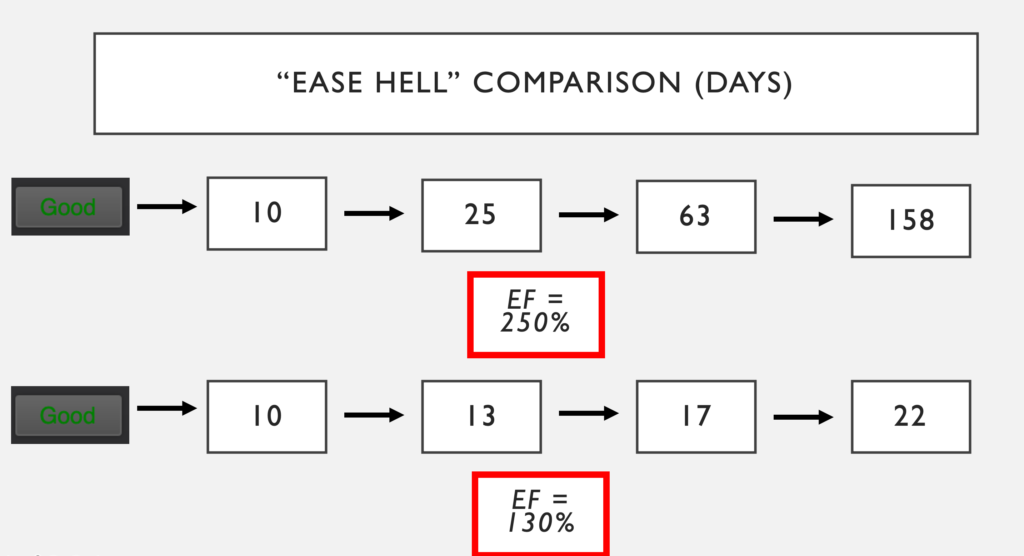
Nosotros desire to avoid "Ease Hell." We want to avert it because nosotros will be seeing too many cards too frequently making Anki unmanageable and inefficient. Anki is an amazing piece of software, but information technology's exactly that, software. If nosotros leave the settings as is we are more than probable to enter ease hell.
How I decided on my settings:
All of the points above mean that nosotros do not want to exist playing with the well-researched algorithm for maximizing retentiveness that decided on this 250% number, which is why we want some wiggle room in the learning phase (the specifics of the algorithm research was kicked off by Ebbinghaus in 1885, developed upon in 1972 past German Scientist Sebastian Leitner in 1972, and farther developed by SuperMemo most recentlyane,2,3. If you want to bank check out my full mail on the reasoning behind spaced repetition go here).
This is where my individual preference comes in, and you will, and should, change these numbers to maximize your gains and personal preference.
In coming upwards with my learning steps I referenced two "gods" in the field of medical school Anki and that is the AnKing and Conaanaa.
AnKing's Steps: 25 → 1440 (i 24-hour interval) → Graduated (3 Days)
Conaanaa's Steps: xv → 1440 (i Twenty-four hours) → 8640 (6 Days) → Graduated (15 Days)
Mentionable Choice (reddit user – anbu5000): 15 → 1440 → 4320 → 8640 → Graduated (fifteen days)
My Steps: 15 → 1440 (1 Day) → 4320 (3 Days) → Graduated (half dozen Days)
In full general, I fall somewhere between the AnKing and Conaanaa's settings. AnKing is harsher, emphasizing high correct rates over more time spent, "put in the extra xxx% time for the five% gains." Aiming for mid to loftier 90s % success rate.
Conaanaa's settings are longer-term, with still high retention, with between 80-90% success rate. His justification being the more than steps yous add together the safer you are from messing with the Ease Gene and, therefore, "Ease Hell."
My justification for my settings:
- We desire to, eventually, start messing with this Ease Factor. This is what helps differentiate specific cards that are more than challenging to united states of america or easier to united states.
- We are trying to maximize our retentiveness in 1-ii years, non 5+ years (I volition adjust my settings towards Conaanaa'southward after Stride 1)
- In medical schoolhouse, nosotros may be quizzed on something we only learned that calendar week that'south why I like to see that card at to the lowest degree twice within five days.
Many cyberspace sources back up Conaanaa'due south 80-90% target, notwithstanding, I had a hard fourth dimension finding peer-reviewed bookish journals in support of this specific number of lxxx-90%4.
In my opinion, the AnKing makes a good point that we want to be higher up 90% for maximizing our Step ane score, still, I recall aiming for the mid to loftier 90s makes the number of cards y'all accept to do unmanageable.
So what did I determine? I want to aim for the high 80s, and then peradventure 88-90%. This combines those 2 ideas. These general settings got me in that ballpark, but, really, I haven't adjusted them for over a twelvemonth. To fine-tune my manner up to xc% I adjust my interval modifier, which, remember is practical to all cards. I volition talk virtually that later on, but apace, if my success rate is also depression I subtract my interval, seeing the cards more often. If my success charge per unit is besides high, I increment my interval, seeing the cards less often.
At present (thankfully) things get a little more straightforward. Let's talk most what "Easy Interval" means.
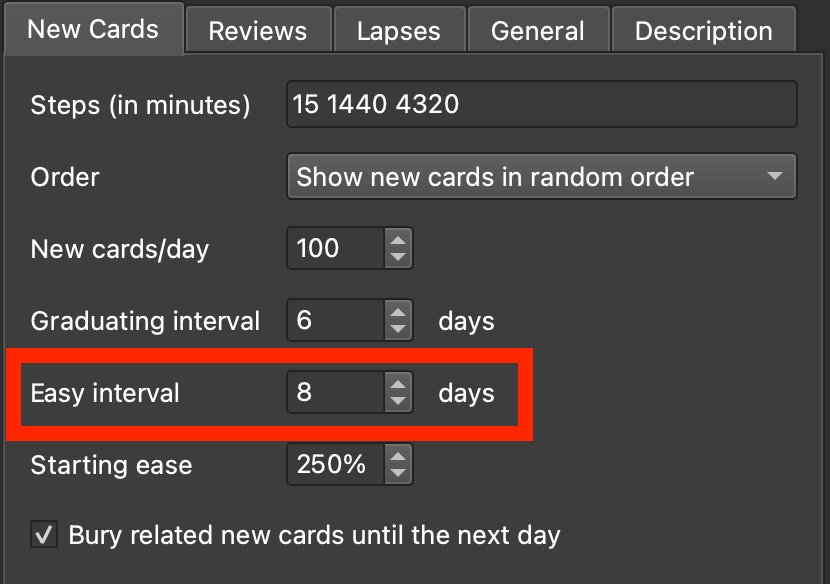
All it means, if that at any point during the learning phase, you hitting "easy" the menu is immediately graduated and shown to y'all however many days afterwards yous select. I chose 8 days because my graduating interval, of vi days, is a day shorter than normal equally if you applied the normal Anki algorithm my graduating interval should be 7 days. Just, remember, we want loftier retention and exposure in that beginning time seeing that carte du jour, which is why I fix it at half-dozen days.
If you are hitting "easy" you lot really know that card. I rarely striking easy, so when I practise it's for good reason. I bumped it a day past the normal, and so eight days.
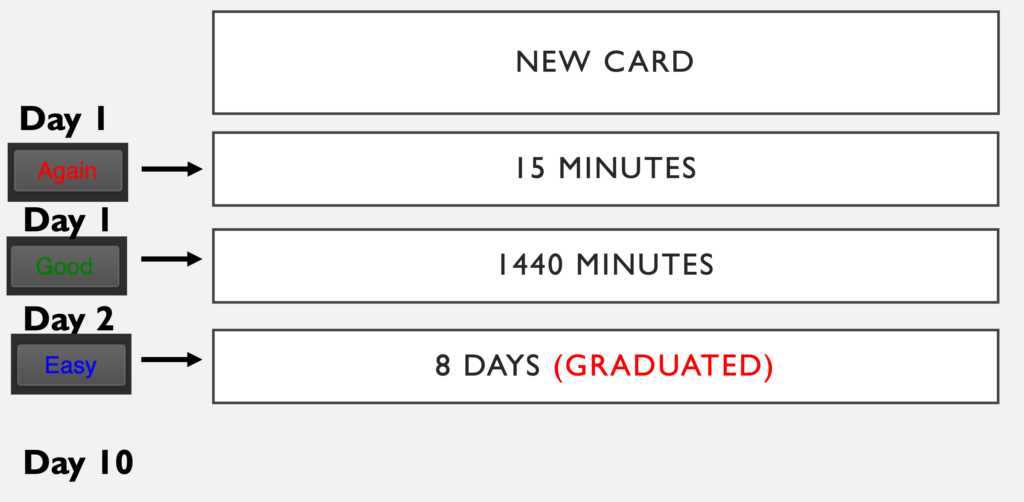
Side by side is "Starting ease," recall nosotros don't want to impact this!! This number was decided upon after many (professional person) experimenters decided upon it1-3. I go along mine at the default 250%.

Side by side, is "Bury related cards until the next twenty-four hours." I enable this. This makes cards that are related, as shown beneath, be separated past one mean solar day.

As discussed with doing reviews in random order, I like to do my new cards in random order as well. This setting is non as important as doing the reviews in random society, just take found it helps again with avoiding the trap of memorization as we tin recollect our new cards by the order that the information is existence presented in as opposed to actually agreement the data.

What this does is if you lot accept a carte du jour like:
2 + 2 = 4
with a cloze deletion of "2" and "4," the carte du jour would appear to y'all twice as:
2 + __ = 4
2 + 2 = ___
These 2 cards could appear on the same solar day, and if they are new cards, and you had this setting disabled, they would appear on the aforementioned day. I don't similar that. I feel like I will just remember the respond of "4" from doing the card before instead of understanding that 2 + ii = 4.
A major gripe I have with Anki is it too easy to fall into the trap of memorization, most of my settings are trying to avoid that trap by emphasizing understanding.
How do we emphasize understanding? Well, I call up, we avoid using short term memory as much as possible. This is why I have my lowest learning step at 15 minutes and why I have this setting enabled.
We are done with New Cards! Well done.
Reviews
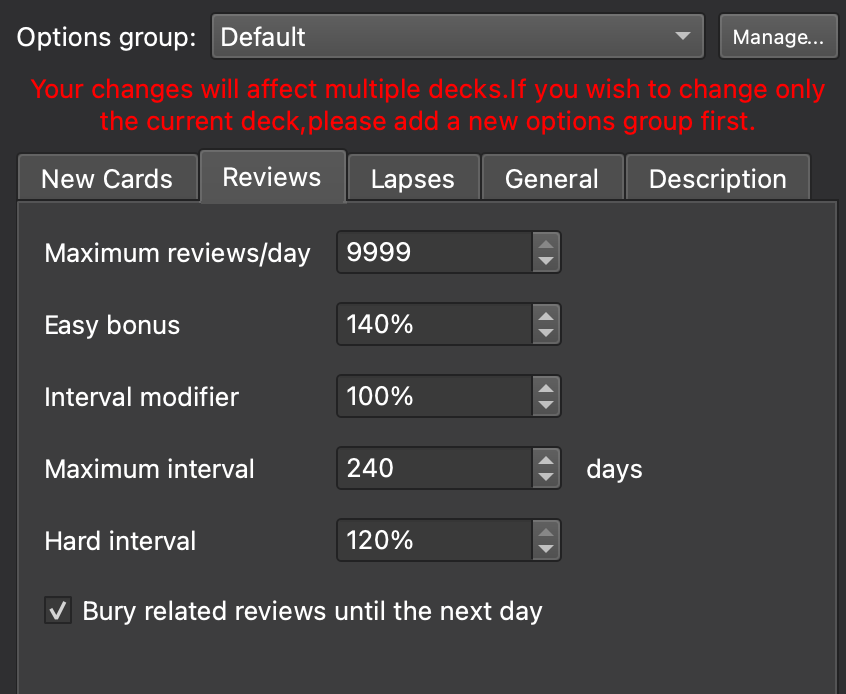
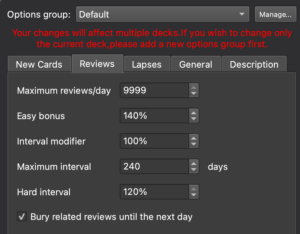
For reviews, the almost important setting is the offset 1. Again, we don't want to mess with the Algorithm at all. If cards are existence pushed to the next twenty-four hours because we maxed out our reviews, we are messing with the algorithm.
Ready your max reviews to 9999 and do all of your reviews, every day.
Next is Easy bonus. I gear up Easy bonus to 140%.

Easy Bonus is fairly straightforward, if you remember this image:
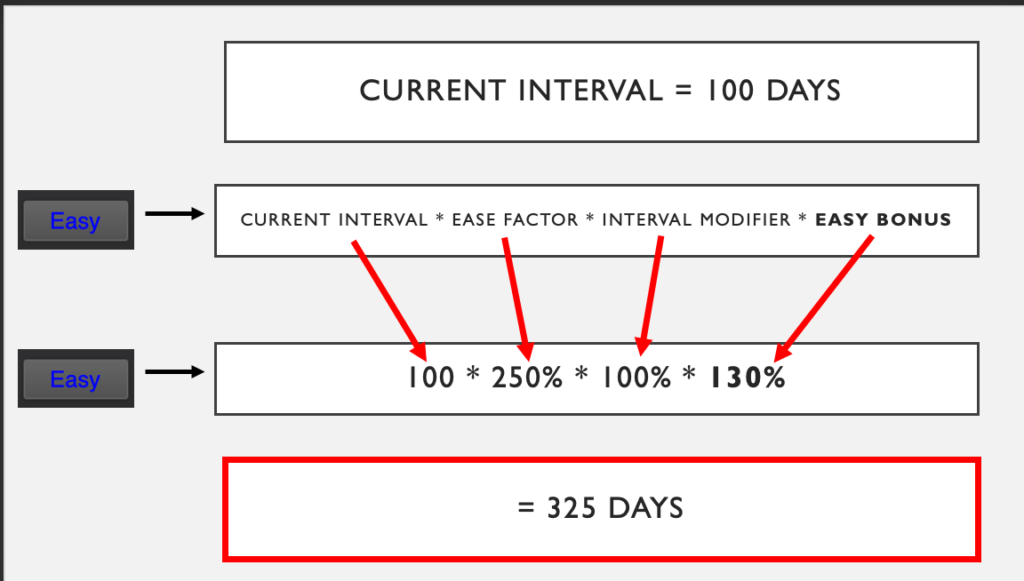
Personally, I rarely hitting "Easy." So when I do it means that menu was really easy for me. I just bumped the number upwardly from the default "130%" to "140%." This isn't groundbreaking, it but works well for me.
Side by side, we are onto another very important detail, however, 1 that is easier to empathize, the interval modifier. I have changed this number a couple of times, right now, I am happy with it at 100%.

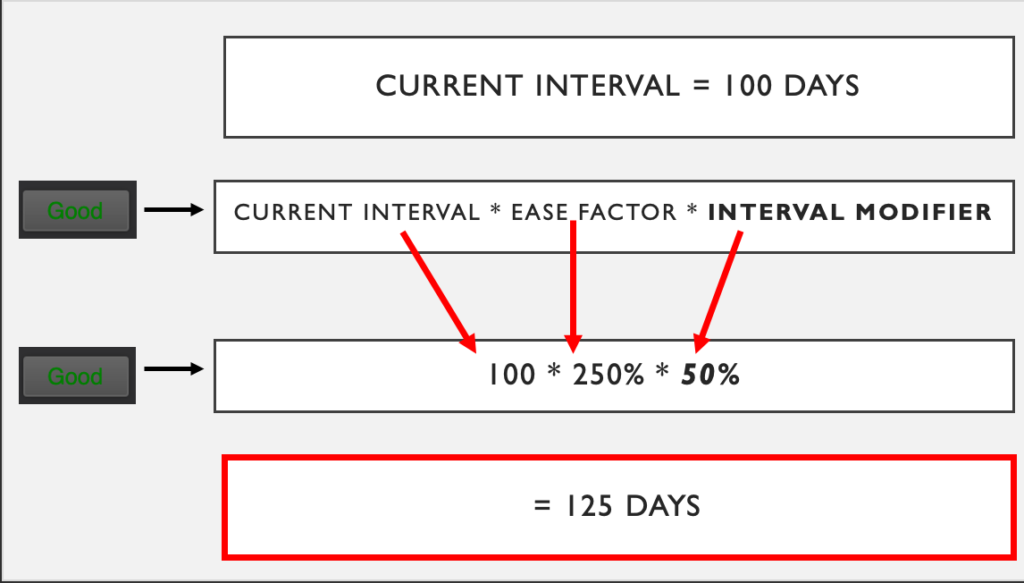
If you are hitting "easy" and "once again" and "hard" at the perfect times, perhaps, you can avert irresolute this number at all. However, sometimes, yous are just seeing cards too oftentimes or too infrequently. Irresolute this number will modify all graduated card intervals as you are doing your Anki cards. Let'southward wait at an case bold you hit proficient with your Interval Modifier at 100%.
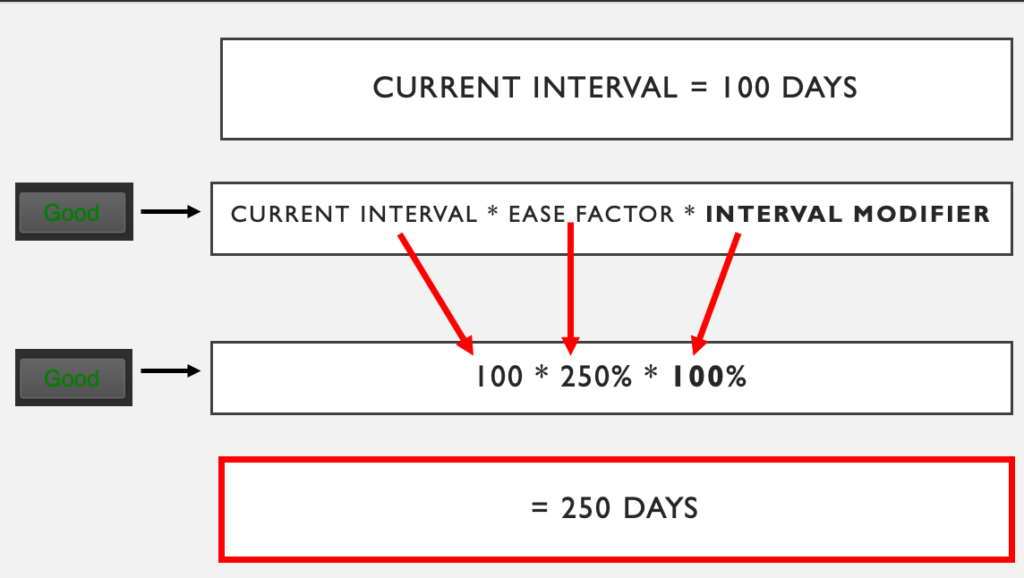
Now if your interval Modifier is fifty% .
Now allow's compare the two in the long term.
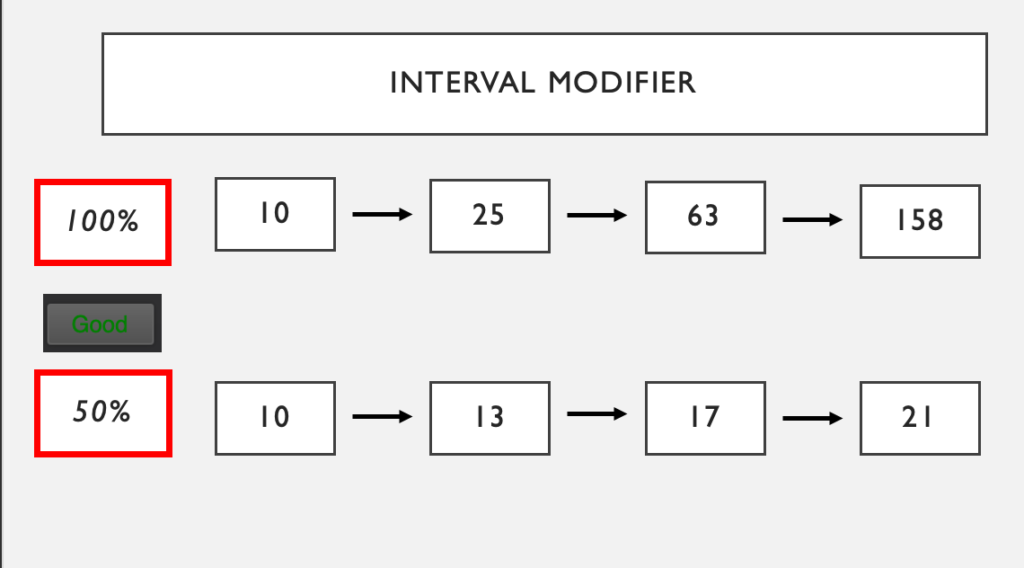
As you can run into this makes a big difference, ok, I remember you know what it does, now let's talk virtually when to change it. If the post-obit is besides confusing/scary for you, it'south ok, just leave information technology at 100% and everything should be fine.
I spoke about this before, merely, in general, I like to aim for a Success Rate of the very high 80s. My reasoning is that I want to score well on Step, we can score well by having a high success charge per unit, however, every bit we endeavor and push that success rate upward the work exponentially increases (something similar 30% extra work for five% gains). Now, that's ok for me, to a point. I tried pushing over the 90% hump and my carte count got too loftier. Also, many other people seem to emphasize an fourscore-ninety% success rate. Then, similar finding just the right temperature oatmeal, I decided on trying to hit equally close to xc% without passing information technology. I'thousand doing pretty well with that.

To get this information merely download the truthful retention app → restart Anki → "Shift-Click" Stats on your deck browser.
What I would exercise, over the by two years, is monthly I would bank check up on this number. If I felt I was seeing likewise many cards, and maybe pushing past 90%, I would increase my interval modifier past five% to see the cards farther autonomously.
If I felt I was seeing too few cards, and my memory rate was dropping to the mid-80s, I would decrease my interval modifier past 5% to see the cards more than frequently.
So what do I suggest for you lot? Well, I am pretty happy with my electric current setup, I don't think it's a bad place to aim for at all. Play with that interval modifier, slowly, and carefully and don't rely on statistics from one twenty-four hours or even i calendar week.
Next things to talk about the maximum interval.

I will defer to a great post past reddit user u/nicolascuri, only he says we should never cap our max interval. I hold with him. Unnecssary repetitions are exactly that, unnecessary.
If you brand this number too small similar 3 months, the number piles upwardly (yellow line). Interestingly subsequently 6 months (pink line), for me, the increasing of the max interval doesn't make of a deviation via this sumaltion. one year is the orangish line.
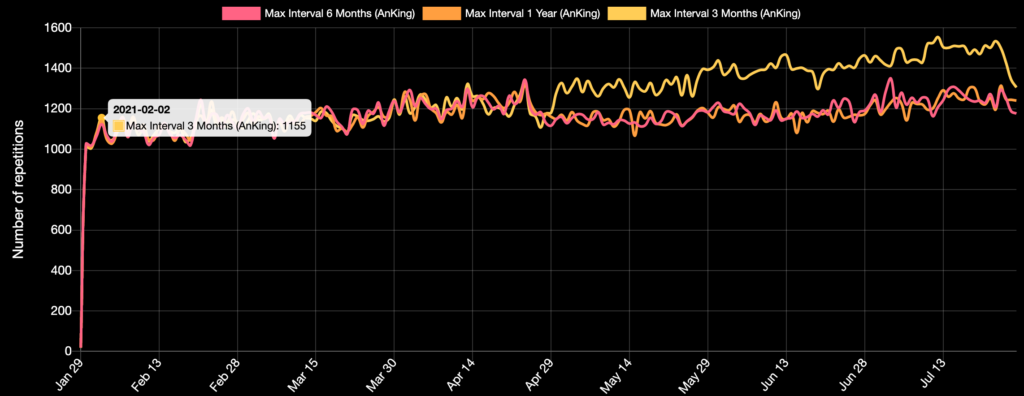
This is using the Anki simulator app which can be accessed here
I recommend setting a max of at least 6 months (180 days) and possibly college if y'all want. To be safe, I will officially recommend 240 Days (8 Months) for the outset two years of medical school.
Next, let's talk almost the hard interval.

I discussed this earlier, but this is just a static number that applies whenever you hit hard on a graduated carte. Don't alter this. I rarely hit difficult. I don't see any reason why you want to conform this. Just for the sake of spaced repetition…
I accept coffin related reviews until the next day enabled.

As spoke about before, I want to avoid memorization. Let'due south employ the "burying" dominion to reviews (on graduated cards) as well as "learning" (on new cards).
Nosotros are on the home stretch now! But lapses to practice and nosotros are washed.
Lapses
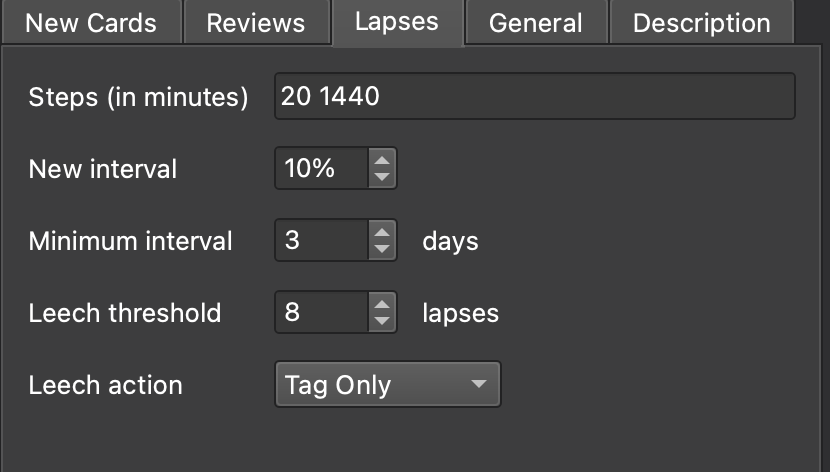
Lapses are what happens when we get a card wrong. If you remember how I described it earlier:
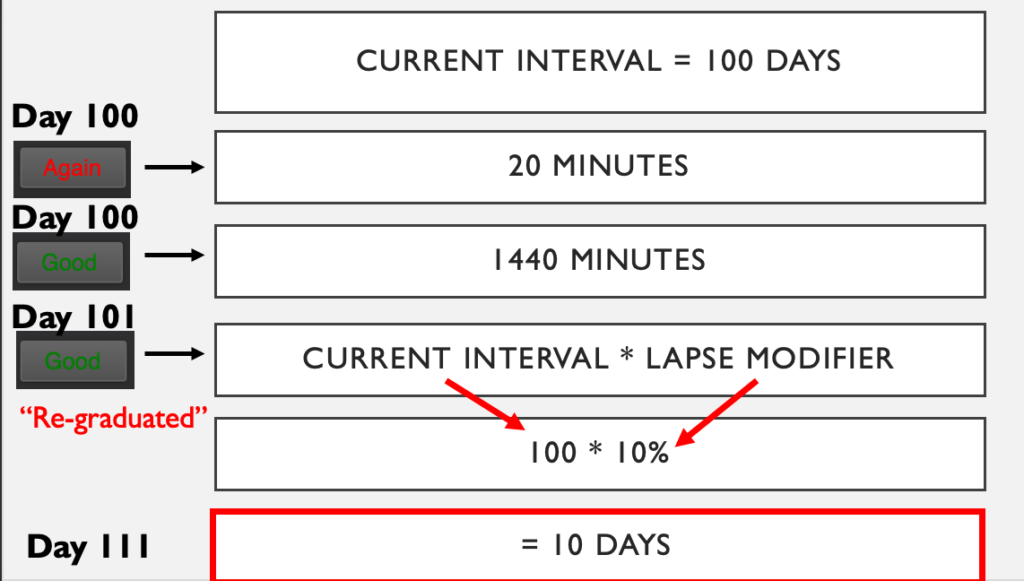

When you get a carte wrong it enters "relearning." It is basically the same equally "learning" a menu except when y'all graduate the card its adjacent interval is determined by your new interval %. I put 1 less interval on the "relearning" phase because I already learned it.

I have my lapse setting at 10% because when I get a card incorrect, I normally really don't know it. I almost need to entirely relearn that card. This is the way I designed my settings. I don't have it at 0% because that makes the card load also high, and, unremarkably the bill of fare will bear witness upwardly too ofttimes for me.
I experimented with the 80% lapse percentage but it was way as well high. I would relearn a card with those steps of 20 minutes and ane day, then if a card had an interval of 100 days, I would meet it again eighty days afterwards. It was definitely not solid enough in my heed to be showed 80 days subsequently, then, what I noticed, is I would get to 80 days with these cards and I would inevitable hit "again," with no understanding of the menu whatsoever.
I suggest you prepare it at 10-30%. I like the 10% number.
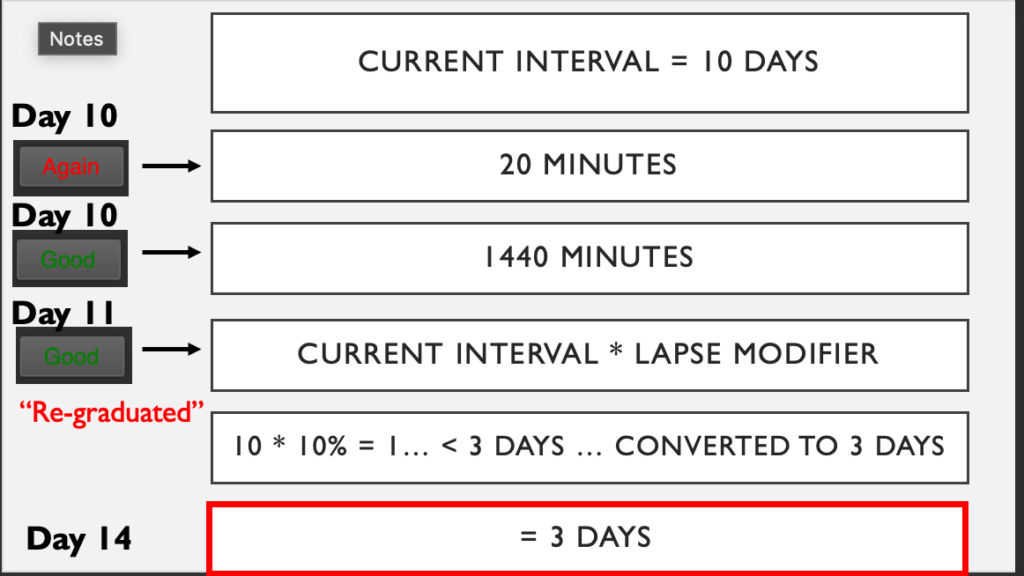
Oftentimes, however, 10% of my current interval of a carte drops the next interval to beneath a 24-hour interval. That's where this setting comes in:

This means, that say I have a bill of fare with an interval of 10 days, I get this carte wrong. 10% of 10 days is 1 24-hour interval. I don't desire to be reviewing this menu at 1 day → 1 day, that is silly, and against the algorithm, so I don't.
Now, allow's talk about leech threshold and leech activeness.
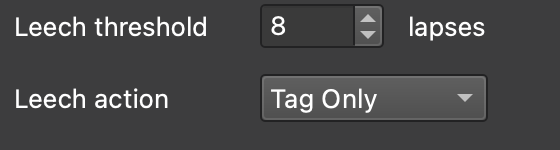
What this means, is if yous hit "over again" 8 times on a graduated menu the card will be tagged equally a leech.
I practice not think the "suspend" setting is a adept idea. We want to practice really well on Pace i, this ways we want to learn these cards that are a struggle for us, non push them to the side.
The other thing to note is that if you have hit "again" 8 times your menu has striking the floor of the Ease Factor. So your Ease Factor is at 130%. That's OK though, call up, we adjusted for the learning phase with our learning steps. So if the Ease Factor is at 130% now it is meant to be there, you need to await at this card, and you lot need to proceed looking at this card.
I can track my leeches and time spent on individual cards, virtually monthly, I will check the cards that are taking me the most time and take some time to learn the facts that are my sticking points.
side note: if you desire to rail your leeches, and the time spen t on every leech, I suggest you download the advanced browser app, which will let yous customize your browser to sort for "time spent" on certain cards.
Full general
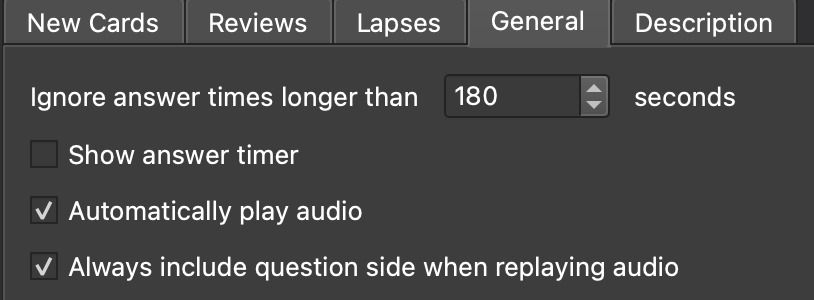
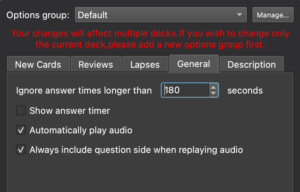
These settings are straightforward.
If I become up from my desk, or look at a card for longer than 3 minutes, Anki assumes me as "afk" and ignores the reply.
I do not like to prove answer time every bit it is distracting.
On the few cards that have audio, I like that to play immediately afterwards I answer.
Fuzz Factor
As an extra piece of data, Anki has a built-in "Fuzz Cistron." What this means is that, on all cards, a dissimilar interval will be applied to cards from lxxx-120% of what the interval would be without the fuzz factor regardless of what push you press.
So when you printing whatsoever push, Anki may give that card an interval of anywhere between 80 and 120 days. This isn't such a huge difference that it'southward messing with the Anki algorithm. This is just put in place then when you introduce new cards, you won't have to review all of them on the same mean solar day.
Honestly, for our situation, this doesn't make much sense as we are doing new cards pretty much every solar day, simply, if, for example, yous did TONS of new cards on i day, and not so much on another day, this would help residuum the load.
If anyone has used load balancer (which I don't recommend using considering load balancer really does mess with the algorithm), this congenital in office is like that.
Final Tips
You must be honest with yourself. "Tip of the tongue" is not good enough. Hitting "again."
If a card is showing up likewise much I but hit "like shooting fish in a barrel." If this is happening across the board I think most changing my interval modifier.
I continuously edit, add images, and practice the Feynman Technique with individual cards.
Otherwise, we did information technology! Thanks for reading and I promise this was helpful.
-Zach
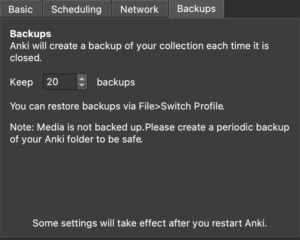
Pictures of My Recommended Settings For Medical School
Work Cited:
- Murre JM, Dros J. Replication and Analysis of Ebbinghaus' Forgetting Curve.PLoS One. 2015;ten(seven):e0120644. Published 2022 Jul 6. doi:x.1371/journal.pone.0120644
- Leitner, Southward. 1. (1991).So lernt human lernen: [angewandte Lernpsychologie – ein Weg zum Erfolg] (Sonderausg., 16. Aufl.). Freiburg im Breisgau [u.a.]: Herder.
- http://www.cc.kyoto-su.ac.jp/information/tesl-ej/ej40/m1.html
- https://eshapard.github.io/anki/target-an-fourscore-ninety-percent-success-rate-in-anki.html
Source: https://zhighley.com/anki-settings/

Post a Comment for "Anki How to Change Again and Good Interval"